
Introduction
Whenever you examine your website’s performance, bounce rate is such a metric that frequently causes worry. Many website owners are often seen asking if their bounce rate is too high or if there is a problem with their website as soon as they access the analytics information.
But instead of worrying, we must first understand what bounce rate actually means. Then, we need to figure out which aspects count as a good bounce rate and how it varies across multiple industries.
In this blog, we’ll explain the Google Analytics bounce rate. We will be comparing bounce rate vs. exit rate and reviewing the average bounce rate by industry. Lastly, we will also share some practical ways on how to improve bounce rate. These will prove helpful to make user engagement and conversions better.
What Is Bounce Rate?
Bounce rate refers to the percentage of visitors who land on a website but do not engage or interact with it and ultimately leave it.
In simple terms, a visitor “bounces” when they:
- Visit one page only
- Do not click on anything
- Do not navigate to any other page of the website
- Leave the website
For example, if there are a total of 100 people who visit your webpage but 60 among them leave it without clicking anywhere, it means that your website’s bounce rate is 60%.
This is where understanding the Google Analytics bounce rate explanation helps you out. It is a measure of how engaging and useful your content seems to the visitors and how long they stay on your website.
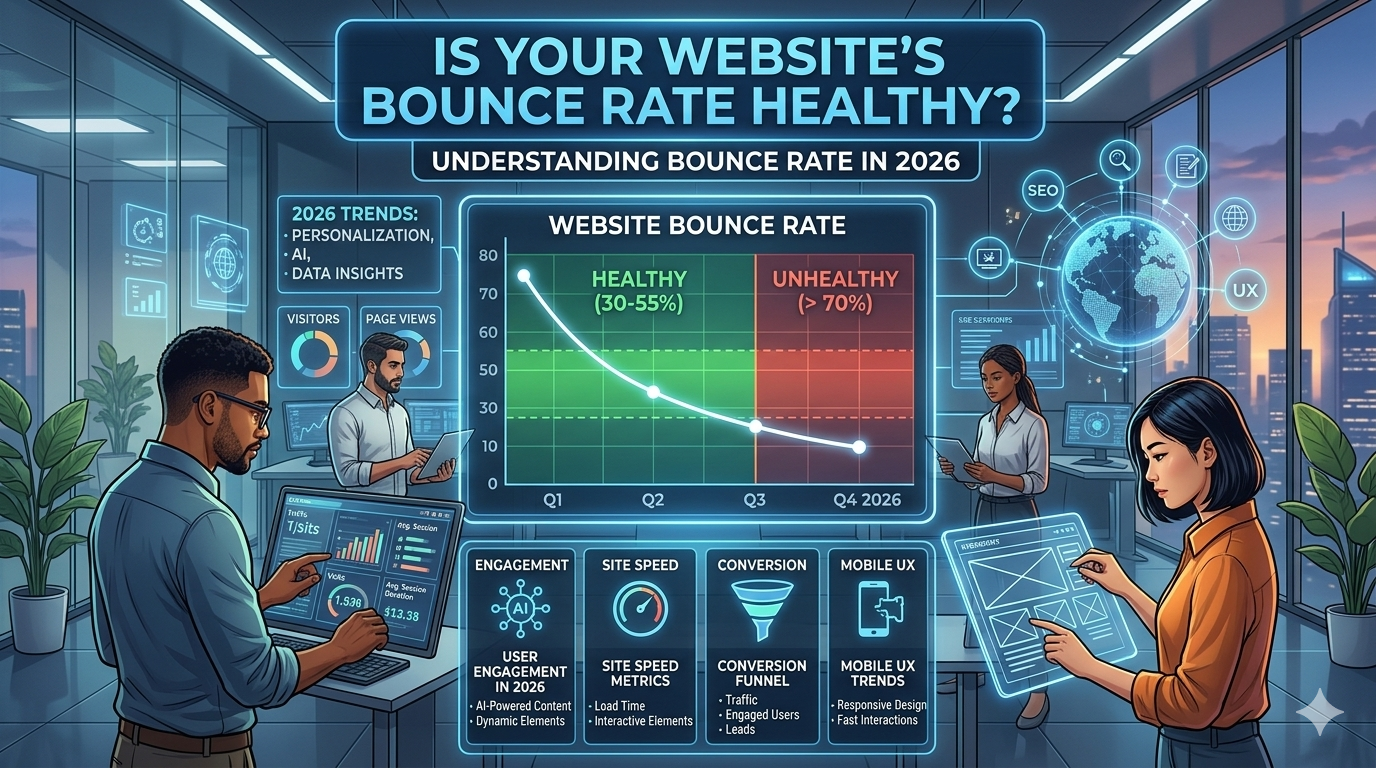
What Is a Good Bounce Rate?
A common question that often arises is: What is a good bounce rate?
Well, the answer is not a one-word or just a single number that we might quote to you. It actually depends on the type of your website and industry to which it belongs.
Generally speaking:
| Bounce Rate | Meaning |
|---|---|
| 25% – 40% | Excellent |
| 40% – 55% | Good |
| 55% – 70% | Average |
| 70%+ | Needs improvement |
However, a blog article may naturally have a higher bounce rate than an e-commerce store.
For example:
- Blog posts often answer one question, so users leave after reading.
- E-commerce websites expect users to browse multiple pages.
So a “healthy” bounce rate always depends on context.
Average Bounce Rate by Industry
Different industries show very different engagement behavior.
Here is a general average bounce rate by industry benchmark.
| Industry | Average Bounce Rate |
|---|---|
| E-commerce | 45–55% |
| SaaS / Tech | 35–55% |
| Blogs / Content sites | 65–80% |
| Landing pages | 60–90% |
| B2B websites | 40–60% |
| Education websites | 45–60% |
The above numbers describe the bounce rate benchmark for 2026. These are completely realistic and based on common analytics studies.
If your website is close to these numbers, it’s a great sign. Now you must be wondering why. Well, it’s a clear indication that your website is performing normally.
Bounce Rate vs Exit Rate
Many people often confuse between bounce rate vs exit rate. In actual, both of these metrics measure different behaviors.
Bounce Rate
Bounce rate measures the number of users who leave after viewing only one page of a website.
Example:
The visitor lands on a blog post and leaves immediately.
Exit Rate
Exit rate measures users who leave the site from a specific page, even if they visited other pages first.
Example:
Visitor goes:
Homepage → Blog → Pricing → Exit
In this case:
- No bounce occurred
- Exit happened on the pricing page
Understanding the difference between bounce rate and exit rate is very important. This difference will help you identify where the users lose interest in your website while navigating it.
How to Improve Bounce Rate
If you find out that your website’s bounce rate is significantly higher than the given industry benchmarks, then do not worry at all. There are several ways that can help you to improve it. Let’s see what these ways are:
Improve Page Loading Speed
Slow websites drive visitors away quickly.
To reduce bounce rate:
- Compress images
- Use caching
- Improve hosting performance
- Minimize scripts
A fast-loading webpage makes a better first impression of your website.
Write Clear and Engaging Content
Visitors decide within seconds whether your page is useful.
Make content easy to read by:
- Using clear headings
- Writing short paragraphs
- Adding visuals
- Answering user questions quickly
Good content naturally lowers bounce rate.
Improve Website Design
A confusing layout or poor mobile design can increase bounce rate.
Ensure your website:
- Is mobile responsive
- Has clear navigation
- Uses readable fonts
- Avoids clutter
User experience plays a major role in engagement.
Add Internal Links
Internal links helps to encourage the visitors to explore more webpages in a website.
For example:
- Related blog posts
- Recommended resources
- Product suggestions
This helps to keep your visitors staying longer on the website. This ultimately improves the engagement.
Use Strong Calls to Action
Clear calls to action guide users to the next step.
Examples:
- Read another article
- Download a guide
- Contact the company
- Explore services
These actions reduce bounce rate and increase conversions.
Google Analytics Bounce Rate Explanation
Google Analytics bounce rate is calculated by dividing single-page sessions by total sessions.
Formula:
Bounce Rate = Single Page Visits ÷ Total Visits
Example:
If a webpage receives:
- 1,000 visits
- 600 single-page visits
The bounce rate is 60%.
Analytics tools use this metric to understand user engagement and identify pages that need improvement.
When a High Bounce Rate Is Actually Normal
Sometimes, a high bounce rate is not a problem.
For example:
- Blog articles that answer a single question
- Contact pages where users only need a phone number
- Dictionary or definition pages
- Single-page landing pages
In these cases, visitors get the information they need and leave — which is expected behavior.
That’s why bounce rate should always be interpreted with context.
Conclusion
Bounce rate continues to be quite a key metric in analytics when measuring the performance of a website. Yet, the value of making the right interpretation of it remains paramount. Website owners changing focus exclusively on bringing the figure down should instead allow themselves to comprehend what a good bounce rate is for their industry, analyze how users are interacting with the content, and identify areas that need improvement.
Enhancing website speed, designing internal linking, and improving content quality are ways of steadily lowering bounce rate and making the user experience better. An experienced bounce rate simply indicates that visitors find your website valuable and decide to delve deeper into it.
FAQs
What is bounce rate?
Bounce rate is the percentage of visitors who leave a website after viewing only one page without interacting further.
What is a good bounce rate?
A good bounce rate usually falls between 40% and 55%, but it varies depending on the type of website and industry.
What is the difference between bounce rate and exit rate?
Bounce rate measures single-page visits, while exit rate measures the page where users leave the website after browsing multiple pages.
How can I improve bounce rate?
You can improve bounce rate by increasing page speed, improving content quality, adding internal links, and optimizing website design.
Does a high bounce rate always mean a problem?
No. Some pages naturally have higher bounce rates because visitors only need quick information before leaving.