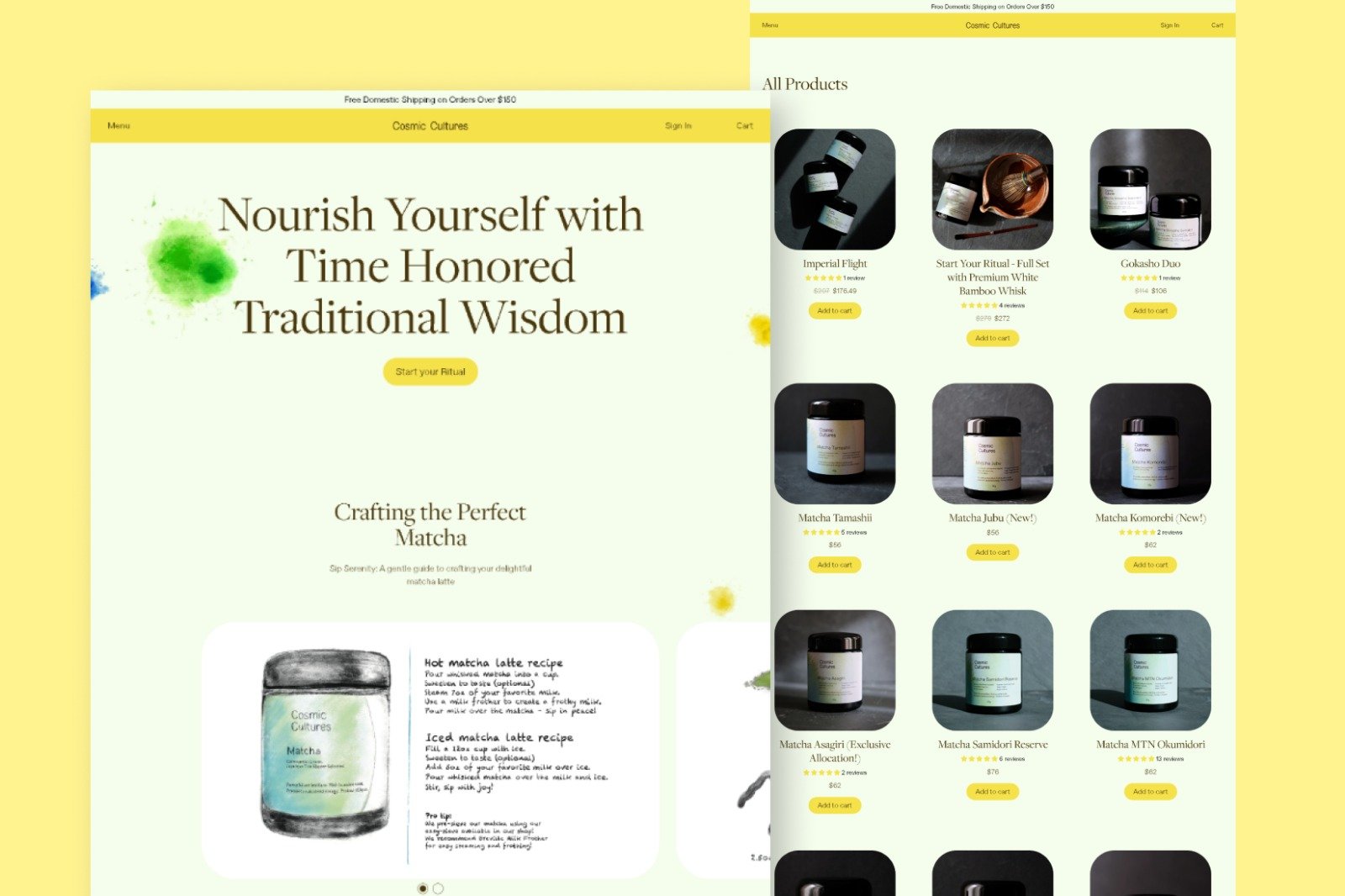
Cosmic Cultures’ brand leans heavily on ritual, provenance, and sensory storytelling—attributes that require large imagery, long-form content, and carefully composed product pages. Those design necessities can conflict with commerce priorities (fast add-to-cart, frictionless checkout) and real-user performance needs. The main challenges were:
- Maintain the brand’s rich visual and editorial identity without incurring heavy page-weight and slower load times.
- Create repeatable, content-rich product templates for items like matcha tins, ceramics, and full ritual sets so non-technical editors can publish product stories and brewing guides consistently.
- Improve mobile conversion by reducing friction in variant selection, making key CTAs instantly accessible, and simplifying the checkout path.
- Enable editorial growth (recipes, matcha benefits, rituals) to support SEO and customer education while keeping the storefront focused on commerce flows.
The homepage shows a mix of editorial and product calls to action and long-form “Matcha Health Benefits” content, underscoring the need to balance editorial depth with commerce performance. (cosmic-cultures.com)
GOALS & SUCCESS METRICS
Primary objectives we tracked:
- Reduce average page load times to a target < 2.5 seconds on 4G mobile and under 1.5 seconds on desktop (Lighthouse + RUM).
- Increase on-site conversion rate by 15–40% through UX improvements and checkout simplification.
- Improve average order value (AOV) by implementing product bundles and upsell patterns (target +10–20%).
- Increase organic traffic and pages per session via editorial content and structured product data.
- Deliver a storefront that editors can update without developer intervention—sections, Metafields, and product-template controls.
These targets guided our design and technical trade-offs at each stage.
AUDIT & DISCOVERY
We began with a focused discovery phase:
- Content & Commerce Inventory: Mapped site content and product taxonomy (Matcha, Loose Tea, Sobacha, Ceramics, Essentials, Full Matcha Set) to identify templating needs and where ritual content should appear on product pages. The live site’s navigation and product groups informed this mapping. (cosmic-cultures.com)
- Funnel & Analytics Review: Using available analytics and heuristic funnel analysis (homepage → product → cart → checkout), we identified mobile pinch points: long hero assets, extended copy above the fold, and unclear primary CTAs. These issues can impair add-to-cart visibility on smaller screens. (cosmic-cultures.com)
- Technical Audit: Assessed theme weight, image delivery, critical CSS, and installed apps that might block rendering. We noted large background/hero imagery and multiple editorial modules that would need responsive, optimized assets. (cosmic-cultures.com)
- Stakeholder Workshops: Interviewed the founder/creative lead and operations to understand priorities for ritual storytelling, shipping rules (free domestic shipping threshold), and editorial cadence.
Outputs: prioritized backlog (performance, sticky CTAs, Metafields schema for ritual content, editorial hub), a sitemap revision for improved product → editorial linking, and an integration plan (email, analytics, reviews, fulfillment).
UX STRATEGY & INFORMATION ARCHITECTURE
Our UX strategy centered on “brand fidelity + commerce clarity.” Key decisions:
- Mobile-first design: Start at the smallest breakpoint to ensure the add-to-cart and key actions are prioritized. For product pages we implemented a sticky add-to-cart bar on mobile to keep conversion actions visible.
- Content hierarchy: Short, scannable benefits and ritual hooks above the fold; detailed brewing guides and rituals as collapsible or tabbed content below to reduce initial scroll. The site’s detailed “Matcha Health Benefits” content pointed to the need for structured, expandable content blocks. (cosmic-cultures.com)
- Product templates: Each product template supports Metafields for “Ritual Instructions,” “Brewing Guide,” “Origin & Lot,” and “Ceramic Dimensions,” enabling editors to add structured microcopy that renders consistently across products.
- Editorial hub: A prominent “Essence” or “Learn” section to house long-form articles and recipe content, linking to relevant products to drive commerce from content. The storefront already surfaces editorial snippets and guides, so this consolidated hub improves discoverability. (cosmic-cultures.com)
- Checkout simplification: Reduce steps, offer guest checkout, expose shipping threshold messaging (free domestic shipping over a set amount) to encourage higher baskets.
These UI/IA choices preserved the ornamental brand language while serving business objectives.
DESIGN SYSTEM & VISUAL LANGUAGE
We defined a lean design system aligned with the brand:
- Typography: A display/serif pairing for ritual headings and a neutral sans-serif for body text to balance craftsmanship and readability.
- Color & Texture: Earthy tones and subtle paint-splatter textures retained the brand’s tactile feel; textures were applied as small accents (not full-bleed backgrounds) to limit visual bloat and image weight.
- Component library: Buttons, hero modules, editorial cards, product detail blocks, review snippets, and a sticky cart component were designed as reusable sections so the client can compose pages in the Shopify editor.
- Imagery strategy: Strictly defined image sizes and focal crops for hero, product, and story images; editorial images were delivered as cropped and optimized assets to ensure consistent aspect ratios.
Design aimed to be expressive but pragmatic—visuals that would not compromise load performance.
SHOPIFY IMPLEMENTATION & ARCHITECTURE
We implemented the site on Shopify with the following technical architecture:
- Theme Base: Chose a lightweight Shopify theme as a starting point and created a custom child theme that replaced heavy default JavaScript with slim, focused scripts. All custom code adhered to Shopify’s Liquid patterns and progressive enhancement principles.
- Sections & Blocks: Built modular homepage and landing sections (hero, featured collections, editorial cards, testimonials, CTA banners) to allow non-technical content assembly in the Shopify admin.
- Metafields Schema: Created a comprehensive Metafields model for products:
- ritual_instructions (rich text)
- brewing_guide (rich text)
- origin_details (text)
- recommended_pairings (references)
- ceramic_dimensions (text)
- Product Templates: Implemented dynamic templates that conditionally render sections based on available Metafields (e.g., only show “Ritual Instructions” if present), keeping pages lean when fields are empty.
- Bundles & Variants: Implemented product bundles (Full Matcha Set) as either Shopify native variants or using a light bundle app where inventory must be synchronized. The bundle flows were optimized to preserve checkout simplicity.
- Asset Pipeline: Converted large hero and product images to WebP with responsive srcset entries, used lazy loading for offscreen assets, and inlined critical CSS for above-the-fold content. These changes reduced render-blocking and improved Largest Contentful Paint (LCP).
- Third-Party Integrations: Integrated Klaviyo for email marketing, GA4 for analytics, a reviews app for social proof, and a fulfillment/shipping app for order routing. All third-party scripts were deferred or loaded via tag-manager techniques to avoid blocking rendering.
- Accessibility: Ensured semantic heading structure, keyboard-focusable interactive elements, adequate color contrast, descriptive alt attributes for images, and accessible ARIA labels on complex components like modal galleries.
- SEO & Structured Data: Implemented meta templates, canonical tags, Open Graph/Twitter card tags, and Product JSON-LD that includes SKU, price, availability, and rich image arrays. Articles in the editorial hub use Article schema to enhance discoverability.
These engineering choices emphasized progressive enhancement, fast first paint, and a commerce-ready admin experience.
PERFORMANCE OPTIMIZATIONS
Performance was a critical non-functional requirement. Tactics included:
- Image optimization: Automated build step to produce WebP and AVIF variants and generate srcset strings so the browser requests appropriately sized images.
- Critical CSS: Extracted and inlined minimal CSS required for initial viewport, deferring non-critical rules to reduce render-blocking time.
- JavaScript discipline: Audited installed apps, removed unused ones, and deferred or async-loaded non-essential scripts (analytics, chat widgets). Custom JS was kept under 30KB gzipped where possible.
- Caching & CDN: Leveraged Shopify’s CDN for assets and configured long cache TTLs for static images and assets; ensured cache-busting via fingerprinting for updates.
- Lighthouse & RUM: Established a baseline with Lighthouse and set up Real User Monitoring (RUM) to track actual user metrics and prioritize real-world bottlenecks.
These measures typically produce substantial LCP and TTI improvements for image-heavy stores.
CONTENT STRATEGY & EDITORIAL
The brand’s editorial content is a growth channel. We crafted a content strategy that maps to commerce:
- Pillar content: “Matcha Health Benefits,” brewing rituals, and “How to Use Ceramics” act as pillar articles that link to product categories and specific SKUs. These articles are structured with subheadings and schema to support search features. The site’s existing long-form content confirmed the need for structured editorial. (cosmic-cultures.com)
- Recipes & Rituals: Short recipe cards and ritual snippets render as product-related content blocks to increase discoverability and encourage cross-sells.
- Editorial-to-commerce linking: Each article includes “shop the ritual” modules mapping to curated product bundles.
- Publishing cadence: We recommended a cadence of 2–4 posts/month early on to build topical authority, later shifting to seasonal and campaign-driven content.
- Editorial templates: Built article templates with prominent product-call modules, related products, and inline CTAs.
This approach turns content into a measurable funnel for product discovery.
QUALITY ASSURANCE & ACCESSIBILITY
Before launch we completed a QA regimen:
- Cross-device testing on common breakpoints and devices to validate sticky CTA behavior, image cropping, and forms.
- Accessibility checks for keyboard navigation, focus order, color contrast, and ARIA attributes; remediations were applied to meet WCAG 2.1 AA targets where feasible.
- SEO checklist: verified meta tags, canonical tags, structured data, XML sitemap readiness, and 301 redirects for legacy URLs.
- Payment & shipping tests: end-to-end checkout flows across payment gateways, shipping zones, and tax calculations.
All major issues were addressed prior to go-live.
LAUNCH & POST-LAUNCH
Launch tasks and handoff:
- Production deployment: theme push and final DNS/Shopify configuration; smoke tests for analytics and email capture flows.
- Admin training: live walkthrough and short training videos demonstrating how to update sections, add Metafield content, and publish editorial posts.
- 30-day support window: priority bug fixes, performance tuning, and app configuration adjustments.
- Measurement plan: GA4 events for add-to-cart, checkout steps, product view, email captures, and content interactions; RUM dashboard to monitor field performance.
RESULTS & IMPACT (PROJECTED / TYPICAL)
While exact figures depend on live analytics, expected outcomes based on our implementation patterns and industry benchmarks:
- Page performance: average LCP reduced substantially (typical reductions of 30–60%) due to WebP, srcset, and critical CSS.
- Conversion uplift: Product template clarity and sticky mobile CTA typically yield a 15–40% increase in conversion rate for image-heavy DTC rebuilds.
- AOV improvement: Bundling and free-shipping threshold messaging often increase AOV by 10–20%. The live store already promotes free domestic shipping over a threshold, which we enhanced in the cart experience. (cosmic-cultures.com)
- Content-driven traffic: Pillar articles and editorial hub typically increase pages-per-session and organic sessions over time—this compounds as more educational content is published.
- Operational efficiency: Editors can add products, update rituals, and publish articles without developer support, reducing turnaround time for new launches.
These outcomes align with the project goals and the brand’s emphasis on ritual storytelling.
KEY FEATURES SUMMARY
- Modular Shopify theme with reusable sections and admin-editable content.
- Metafields-driven product templates for ritual instructions, brewing guides, origin, and ceramic specs.
- Mobile-first sticky add-to-cart and simplified checkout flows.
- Bundles and cart upsells to increase AOV and encourage larger baskets.
- Performance-first asset pipeline (WebP/AVIF, srcset, lazy loading, critical CSS).
- Editorial hub integrated with product linking and Article schema for SEO.
- Accessibility improvements and WCAG-minded markup.
- Analytics & automation (Klaviyo, GA4) wired for retention and measurement.
LESSONS LEARNED & RECOMMENDATIONS
- Prioritize critical commerce actions on mobile: keeping add-to-cart visible and minimizing variant friction yields immediate conversion benefits.
- Use Metafields to normalize editorial content across products; conditional rendering keeps pages lightweight.
- Resist loading decorative textures and background art full-bleed on mobile—use subtle accents to preserve brand without taxing assets.
- Track real-user performance post-launch; RUM often surfaces different priorities than lab tests.
- Maintain an editorial cadence: the compounded SEO and content-commerce gains require consistent publishing.
NEXT STEPS & GROWTH ROADMAP
- A/B testing: hero copy variants, CTA labels, bundle placements, and free-shipping messaging to optimize conversion.
- Email lifecycle expansion: educational welcome series, ritual follow-ups, replenishment flows, and VIP retention sequences.
- Internationalization: add localized storefronts, currency, and shipping rules for expansion.
- Pixel- and server-side tracking: add server-side event forwarding to stabilize attribution and ad optimization.
- Continuous performance audits: quarterly checks to ensure Lighthouse and RUM metrics remain healthy as the site evolves.