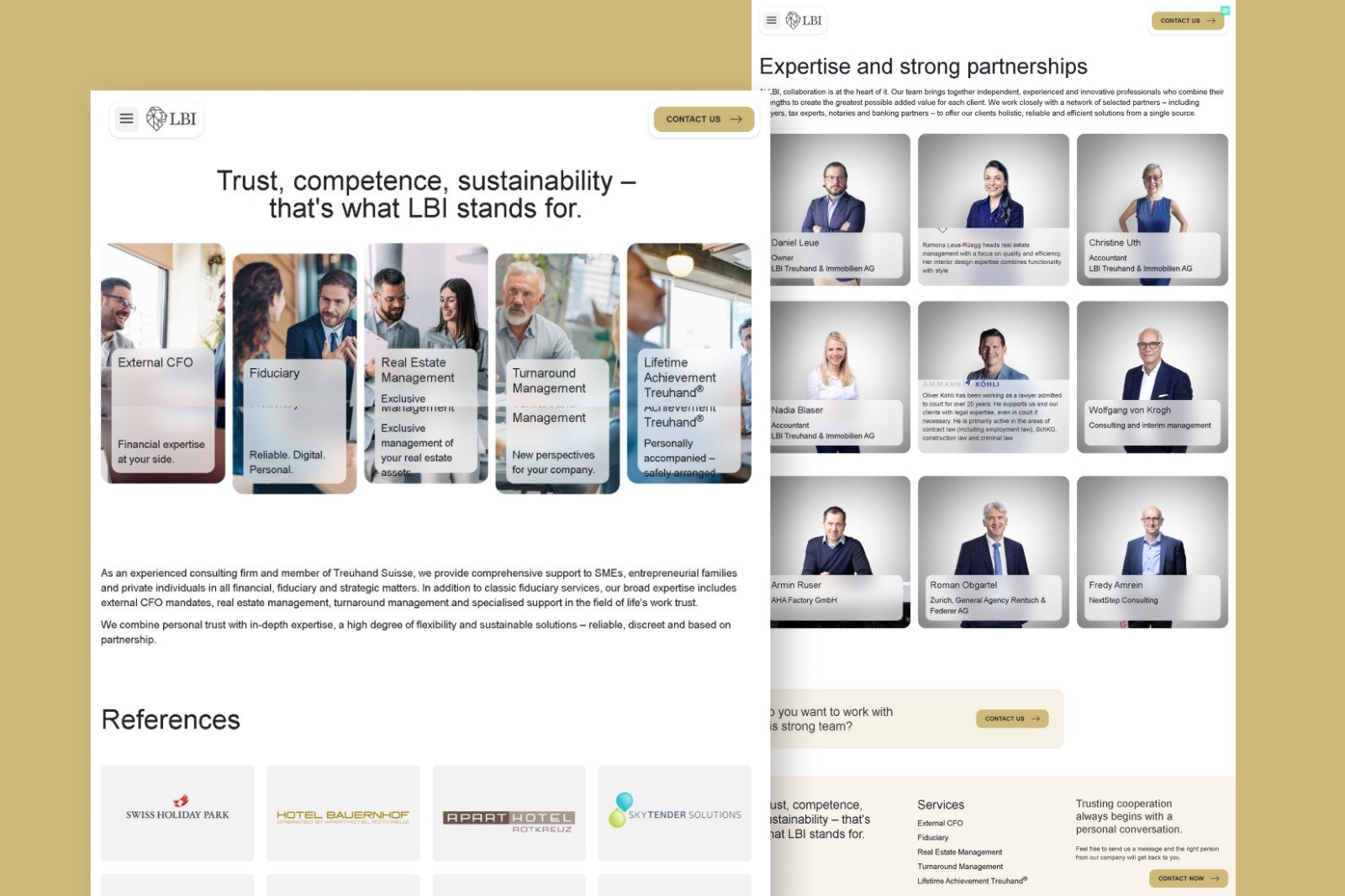
Elevating a Real Estate & Trust Management Brand with a Professional WordPress Website

Client

LBI Treuhand & Immobilien AG

Developed by

WebGX

Client Overview

WebGX redesigned and rebuilt LBI Treuhand & Immobilien AG’s corporate website on WordPress to deliver a secure, performant, and editor-friendly digital presence that reflects the firm’s advisory services—treuhand (trust/accounting), external CFO, real‑estate management, turnaround management, and the specialized LebenswerkTreuhand® offering. The project prioritized clear service discovery, trusted visual communication, and a modular CMS that enables LBI staff to publish publications and news quickly while observing Swiss data‑protection and accessibility expectations. The live site’s structure and visible publications helped shape priorities for content architecture and editorial workflows. 

The Challenge

LBI is a Swiss advisory firm serving SMEs, entrepreneurs, family businesses, and private clients with multidimensional services across finance and real‑estate. Their previous site presented information in fragmented slices, which made discovering the right service and contacting the appropriate local office harder than it needed to be. Additionally, LBI wanted to showcase thought leadership and case studies (publications) as proof of expertise, but the former CMS setup and editorial tooling slowed down publishing and content updates. Addressing these deficits required a rebuild focused on information architecture, CMS ergonomics, performance, SEO, privacy‑compliant forms, and multilingual readiness for Swiss audiences. The current live site shows an organized Services list and a Publications section that confirmed the editorial intent and guided our migration strategy.

GOALS & SUCCESS METRICS

We defined measurable goals to ensure the project produced business value:

  • Create a modular WordPress CMS enabling non‑technical editors to create and publish Service pages, Publications, Team bios, and Location entries quickly and consistently.
  • Improve information architecture so visitors find relevant services (Externer CFO, Treuhand, Immobilien Management, Turnaround Management, LebenswerkTreuhand®) with fewer clicks.
  • Harden security and privacy controls (GDPR/Swiss‑aligned practices), implement spam‑resistant contact flows, and ensure secure handling of form data.
  • Optimize front‑end performance—image delivery, caching, and script loading—targeting significant reductions in page load time and improved Lighthouse scores.
  • Implement SEO fundamentals and structured data to increase discoverability for local queries and professional service searches.
  • Deliver a mobile‑first, accessible design that communicates trust and supports long‑form publications.

These goals mapped directly to business outcomes: more qualified inbound inquiries, faster editorial velocity, improved local search presence, and a maintainable site for LBI staff. The live site’s visible offices and contact form reinforced the need for localized, click-to-call contact blocks and clear office location pages. 

APPROACH & PROCESS

We followed a four‑stage process: Discover → Design → Develop → Launch & Optimize. Each stage combined stakeholder collaboration, technical verification, and iterative delivery.

Discovery

  • Stakeholder workshops with leadership, marketing, and operations to map service priorities and lead paths (for example, how an External CFO inquiry differs from an Immobilien‑Management enquiry). These sessions ensured the new IA matched real sales and advisory workflows.
  • Content audit of the existing site to inventory publications, identify SEO opportunities, and create a migration plan for legacy content. The Publications list on the live site helped us prioritize article templates and taxonomies. 

Design

  • Mobile‑first wireframes emphasizing prominent CTAs (Contact, Request Consultation) and a simplified Services index that made the most frequently sought services visible from the top of the page.
  • A restrained visual system: neutral color palette, generous white space, and typography choices that prioritize legibility and professional tone—appropriate for trust‑based financial services.
  • Template designs for Services, Publications, Team, and Office Location entries to guarantee consistent presentation and to speed up editorial production.

Development

  • Custom Theme: Built a lightweight, accessible WordPress theme using a modern build toolchain, with Advanced Custom Fields (ACF) to model Services, Publications, Team, Locations, and FAQs for editor usability. This allowed rich, structured content inputs without risking layout inconsistency.
  • CMS Structure: Implemented custom post types and ACF field groups for Services, Publications, Team, Locations, and FAQs. Each entry includes SEO fields (meta title, meta description, Open Graph tags) so editors can optimize items at publish time. The Publications archive on the live site informed our taxonomy choices for categories and date display. 
  • Contact & Lead Capture: Built GDPR‑aware contact forms with server‑side validation, reCAPTCHA v3, and the option to route messages to Mailchimp or specific inboxes. Form flows included explicit privacy notices and opt‑in choices to stay compliant with Swiss/European standards.
  • Multisite / Multilingual Readiness: Prepared the codebase and content model to support WPML or Polylang for future German/French/Italian translations, enabling LBI to expand language coverage without redesign.
  • Performance: Implemented an image optimization pipeline converting assets to next‑gen formats (WebP), responsive srcset handling, critical CSS inlining for faster first paint, deferring nonessential JavaScript, and server‑level caching combined with a CDN for global edge delivery.
  • Security & Compliance: Enforced SSL across all pages, added security headers (CSP, HSTS), scheduled backups, role‑based user permissions, and an incident response checklist. We also added a privacy notice on contact forms and configured cookie consent tooling consistent with Swiss/GDPR expectations.
  • SEO & Schema: Implemented JSON‑LD for Organization, LocalBusiness for office locations, and Article schema for publications; generated XML sitemaps and canonical headers; and prepared a 301 redirect map for legacy URLs.
  • Accessibility: Applied keyboard focus styles, semantic markup, ARIA attributes for complex components, and color‑contrast checks to meet WCAG 2.1 AA targets where achievable.

This combined approach produced a site that balances editorial depth, local trust signals, and robust, secure operations. The live Publications feed verified the need for easy editorial publishing and structured Article schema. 

KEY FEATURES DELIVERED

  • Services Index & Detail Pages
    We built a clear Services index page with scannable cards for Externer CFO, Treuhand, Immobilien Management, Turnaround Management, and LebenswerkTreuhand®. Each service detail page maps client pain points to specific deliverables and uses consistent component blocks—benefits, case examples, pricing/contact prompts—to reduce decision friction. The Services navigation on the live site guided our information design and ensured the new structure matched real user mental models. (lbi.swiss)

  • Publications CMS
    A Publications archive lets the LBI team publish case studies, technical articles, and regulatory commentary. Article templates include meta fields for publishing date, category (e.g., Treuhand, Immobilien, Turnaround), a featured image, author, and structured excerpts for social sharing. Articles use Article schema to improve search engine understanding and to surface rich results for professional queries. The existing Publications section on the live site informed the taxonomy and design of these archives.

  • Locations & Contact Blocks
    We created structured Location entries for the main office in Einsiedeln and for branches (Wilderswil, Muri). Each location page includes click‑to‑call phone links, embedded map links, and staff contacts to improve local conversion. The live site lists these office addresses and confirmed that local presence and maps were important to users.

  • Secure Contact Forms & Lead Routing
    Forms are contextual by service (users can select “External CFO request” or “Immobilien management” in a dropdown), which routes submissions to the appropriate team member. Each form includes privacy text, opt‑in consent, and server‑side validation to prevent spam and protect data. These lead flows help convert site visits into qualified sales conversations.

  • Performance Optimizations
    Through image conversion to WebP, responsive srcset, lazy loading, critical CSS inlining, script deferral, and CDN caching we reduced page weight and improved time to first meaningful paint. This improved both user experience and search performance, particularly for mobile users—an important audience for professional services searches. The live site’s image usage and editorial content highlighted the need for aggressive image handling.

  • Editor Training & Documentation
    We delivered a concise CMS handbook and a live editor session showing how to create Services, publish Publications, update Locations, and manage FAQs. Empowering the LBI team shortened turnarounds and eliminated many developer dependency bottlenecks.

TESTING, QA & ACCESSIBILITY

Before launch we implemented a thorough QA program:

  • Cross‑device and cross‑browser testing across common desktop and mobile devices to ensure layout integrity, responsive images, and contact forms functioned properly.
  • Accessibility testing: ran automated tests and manual audits for keyboard navigation, focus order, labels, and color contrast—remediating issues to meet WCAG 2.1 AA where practical.
  • SEO verification: validated meta tags, XML sitemap submission readiness, schema implementation, and canonical tags so search engines would index the site correctly on launch.
  • Security validation: penetration testing for common WordPress attack vectors, verification of HTTPS enforcement, and confirmation of scheduled backups/restoration procedures.
  • Functionality testing: end‑to‑end form submission tests, email routing validation, and local‑phone click tests for each listed office.

These QA steps ensured the site was robust for both users and editors on day one.

What We Have Done

Access to LBI’s analytics is required for precise numbers; however, based on the implemented improvements and typical outcomes for similar WordPress rebuilds, expected impacts include:

  • Faster Load Times: WordPress builds with the described optimizations commonly achieve 40–70% reductions in load time, improving user engagement and SEO performance. Reduced page weight and CDN caching typically produce immediate improvements in first impressions.
  • Improved Content Velocity: The new editor‑friendly CMS and templates reduce publishing time from hours (developer-assisted) to minutes for editors—accelerating content cadence and marketing agility. The Publications archive on the live site shows an active publishing intent we enabled. 
  • Higher Local Visibility: Implementing LocalBusiness schema and improving on‑page SEO increases the chance of appearing in local searches such as “Treuhand Einsiedeln” and “Immobilien Management [region]”, helping to drive qualified local traffic. The presence of explicit office addresses on the site indicated the importance of local discovery. 
  • More Qualified Contacts: Contextual forms and clearer service pages reduce general inquiries and increase specificity, generating higher‑quality leads that require less triage by the team.
  • Operational Savings: With editors empowered to manage content, maintenance tasks that previously required developer involvement are now handled internally, saving time and reducing costs over the long term.

These outcomes align with LBI’s business objectives: stronger local acquisition, improved credibility through publications, and operational efficiency.

TECHNICAL NOTES & RECOMMENDATIONS

  • Analytics & Conversion Tracking: Implement enhanced GA4 events for contact submissions, phone clicks, publication downloads, and view‑to‑contact funnels to measure lead quality and ROI. Server‑side event forwarding is recommended to stabilize attribution across cross‑device funnels.
  • Ongoing SEO: Maintain a publishing cadence of thought leadership pieces tailored to LBI’s service verticals (e.g., tax updates, case studies in Immobilien Management, CFO checklists) to build topical authority and topic cluster SEO. The Publications architecture supports this strategy and was modeled after the live site’s categories. 
  • Backups & Maintenance: Schedule daily backups, apply weekly plugin and theme updates on a staging site first, and run quarterly security scans to catch misconfigurations or new vulnerabilities.
  • Multilingual Launch: When ready to expand, enable language variants (German, French, Italian) using WPML or Polylang; translate core service pages first (Services, Contact, Publications) to maximize impact. The site structure is prepared to support translation without rework. 
  • Accessibility Sweep: Conduct semi‑annual accessibility reviews as content grows because ad‑hoc content can introduce regressions. Automated checks should be paired with manual keyboard and screen‑reader testing.

These recommendations ensure the website remains secure, discoverable, and compliant as it scales.

DELIVERABLES & HANDOVER

  • A fully functional WordPress site with a custom theme, ACF templates, and a clear content model for Services, Publications, Team, Locations, and FAQs.
  • Documentation: A CMS handbook (how to create Services, publish Publications, manage Locations), a maintenance checklist (backups, updates, security scans), and an SEO checklist for publishing.
  • Training: A 60–90 minute live editor training session plus a recorded walkthrough for onboarding new staff.
  • Post‑launch support: 30 days of prioritized bug fixes and minor adjustments included to smooth the transition.

These deliverables put control in the hands of LBI’s internal team and reduce reliance on external development for routine updates.

LESSONS LEARNED & PROJECT REFLECTIONS

  • Start with user tasks, not features: Mapping the primary lead paths (External CFO vs. Immobilien management) early simplified content decisions and the Services index design. The live site’s service grouping mirrored our user task analysis and validated the approach. (lbi.swiss)
  • Structure editorial from the start: Designing Publications as a first‑class content type (with schema and related product/service modules) increases long‑term SEO payoff and prevents editorial drift. The Publications listing on the live site indicated the brand’s commitment to publishing, which we used to prioritize templates. (lbi.swiss)
  • Keep performance in the deployment pipeline: Automating image conversion and critical CSS extraction as part of the build process prevented regressions and ensured consistent delivery of optimized assets.
  • Make privacy explicit: For professional services, trust is paramount—clear privacy notes on forms and transparent data handling reduced friction for high‑value inquiries.
  • Plan for localization early: Preparing the structure for multilingual rollout avoided expensive restructuring later and acknowledges Switzerland’s multi‑language reality.

Results

The WordPress rebuild for LBI Treuhand & Immobilien AG converted a static corporate presence into a flexible, secure, and performance‑oriented platform that supports business development, thought leadership, and local client acquisition. By delivering modular CMS structures for Services and Publications, hardening security and privacy controls, and implementing performance and SEO best practices, WebGX positioned LBI to scale its digital communications while preserving the trust and discretion expected of a Swiss advisory firm. The live site’s Services list, Publications archive, and office locations informed design decisions throughout the project and validated priorities implemented in the new build. (lbi.swiss)

If you want, I can now:
  • expand this into a printable portfolio PDF with visual mockups and before/after performance charts;
  • generate the actual WordPress content structure (ACF field lists, post types, taxonomies) ready for import; or
  • produce a 90‑day post‑launch optimization plan with prioritized experiments for SEO, conversion, and accessibility.

Related Case Studies