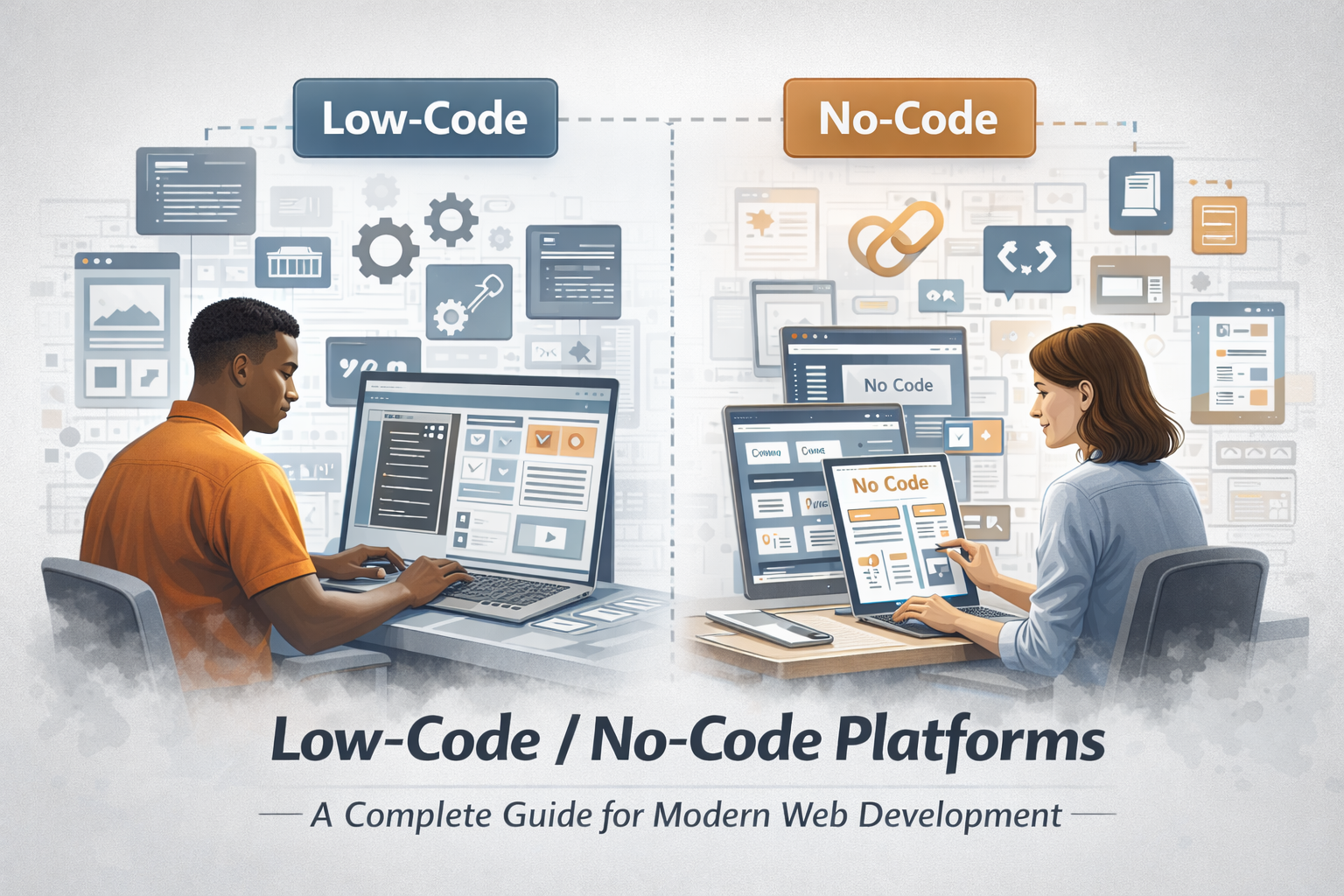
In today’s digital world, a huge transformation is seen in web development due to low-code and no-code platforms. These platforms have provided new and even simpler ways to build websites and web applications. Developers don’t need not write thousands of lines of code. Instead, they can visual tools to create applications.Through visual builders, drag‑and‑drop components, and pre‑built logic blocks, it has become easier to create functional web apps. Developers use builders. Non‑technical users use drag‑and‑drop components.
Businesses these days expect the development to be fast with their websites being very flexible. They also want to lower the costs. This is where low-code web development fits the need. Low-code web development platforms let teams launch products quickly. Low-code web development platforms let teams avoid relying on coding.
The no-code platforms were designed mainly for non-developers. A big advantage of low-code platforms is they allow the developers to add some custom code wherever they need. This makes them a powerful hybrid solution. Such solutions are being used widely for startups and enterprises. Even experienced web developers use them frequently too.
How Low-Code Web Development Works
Low-code web development platforms provide a visual environment to build web applications. Such environments provide components for development. So, there is no need of writing lengthy codes from scratch.
Let’s find out how it usually works:
- Visual Interface: Developers can design layouts in minutes with the help of drag-and-drop elements like buttons. They can even create forms, tables and charts.
- Pre-Built Logic: There are pre-built logic building for common features such as authentication and workflows. Further, handling database connections is built in too.
- Integrations: Most low-code platforms provide easy support for APIs or any third-party integrations.
- Custom Code Option: There is flexibility to add custom code as well. Hence, developers can easily write custom JavaScript, CSS, or backend logic if they need any advanced functionality.
This approach significantly reduces the development time. It also provides flexibility. That’s why low-code web app development has become really popular across different industries these days.
Popular Low-Code Platforms
There are many low-code platforms available today for web development. Some of the most popular ones include:
1. OutSystems
OutSystems is widely being used by many enterprises for building scalable web and mobile applications. It is a great option specifically when you want to build an application with stronger performance, security and more customize features.
2. Bubble
Bubble is a choice for startups. Bubble lets users build web applications without writing code. Bubble also supports workflows and databases. We have seen Bubble help new companies get their ideas online quickly.
3. Webflow
Webflow is a code platform that focuses on the front end and design. We use Webflow to build the websites we need. It is a nice option for the HTML and CSS coding part that usually keep the website fast.
4. Mendix
Mendix is a popular tool particularly being used for rapid application development and enterprise-grade solutions. Therefore, it is a suitable option for large organizations.
5. Appgyver
Appgyver gives you both the no-code and low-code tools. It includes the backend logic for building apps. It is a useful tool for both beginners and expert developers.
These low-code web development platforms are being used for multiple applications from simple landing pages to even complex enterprise systems.
Benefits for Businesses & Startups
Low-code development platforms offer many advantages particularly to those businesses that are trying to scale quickly.
Faster Time to Market
Applications can now be built in just a few weeks instead of many months. So, the businesses can launch their products quickly in the market.
Cost-Effective Development
Now only a few developers are needed. It reduces development as well as maintenance costs.
Easy Maintenance
Maintenance has become easier as updates can be made instantly. The changes are really easy to implement and there is no need to rebuild the entire system as well.
Accessibility for Non-Developers
Non-developers such as product managers, marketers, and founders can participate directly in building applications.
Scalability
There are many low-code platforms available that support enterprise-level scalability and security.
For startups,
Using low-code web development platforms, the startups can launch a product quickly. Hence, they tend not to miss valuable market opportunities.
Limitations of Low-Code
Despite the benefits, low-code platforms have a few limitations too.
Limited Customization
We have seen that the platforms limit how much you can customize the layouts. We have also seen that the platforms limit how much you can customize the logic and the performance.
Vendor Lock-In
We have seen that when a team builds on a platform, the team often has to move from the platform to another system. The move is hard.
Performance Constraints
In our experience, complex applications or high-traffic applications can have performance limits. Those limits can slow the applications down.
Security Concerns
Most platforms are secure. However, few businesses still rely on the third‑party infrastructure.
Due to these limitations, low-code can not always be the best choice for every project.
Do Web Developers Like Using Low-Code?
This is a common question: Do web developers like using low code?
The answer is mixed.
What Developers Like
- Faster development for repetitive tasks
- Less boilerplate code
- Ability to focus on logic and problem-solving
- Rapid prototyping
What Developers Dislike
- Limited control over architecture
- Debugging can be difficult
- Dependency on platform updates
There are many developers who don’t consider low-code as a complete replacement of traditional web and app development. However, it is being found to be a great tool to improve productivity.
Nowadays, experienced developers combine low-code platforms with custom coding to deliver projects efficiently and quickly.
When to Use Low-Code vs Custom Development
The choice of low-code or custom development basically depends on your project requirements.
Use Low-Code When:
- You need a quick MVP
- Budget and time are limited
- The app uses standard features
- Non-developers need to manage updates
Use Custom Development When:
- You need full control over performance
- The application is highly complex
- Security and compliance are critical
- Long-term scalability is a priority
A hybrid approach is also common, where low-code tools handle basic features and custom code handles advanced functionality.
Conclusion
We notice low-code platforms and no-code platforms changing web development. We notice that low-code platforms and no-code platforms give speed, affordability, and accessibility. We notice low-code platforms and no-code platforms fit the startups and fit the businesses that need to move.
From our experience, the low-code web app development has limits. The low-code web app development does not aim to replace coding. Low-code web app development works in conjunction with coding. The low-code web app development cuts work and speeds up innovation.
For many teams, the smartest approach is knowing when to use low-code and when to rely on custom development.
FAQs
What is low-code web development?
Low-code web development uses visual tools and minimal coding to build web applications faster.
Are low-code platforms good for startups?
Yes, they help startups launch MVPs quickly with lower costs.
Can developers use low-code platforms?
Absolutely. Many developers use them to speed up development while adding custom code when needed.
Is low-code suitable for large applications?
It can be, but very complex or high-performance apps may still require custom development.
Do low-code platforms replace developers?
No. They change how developers work but do not eliminate the need for skilled developers.